I get that this sounds sacrilegious or inflammatory but hear me out. I have two Tarot quads, one has longer arms to accommodate more powerful motors that drive 17" propellers
Both are untuned, though I have tried unsuccessfully to get autotune to run. Anyway, I watched a video produced by Chris Rosser on setting up notch filters, in an effort to understand what they are and how to set them up. I now have a superficial understanding of them and recognize that especially for my larger quad, with its longer arms and propellers there must be significant vibration spikes at higher frequencies that need attenuation. But I have a problem.
I’m using T-Motor Air ESCs that do not have the DShot protocol and so I cannot get RPM data needed to set up the notch filters directly over the peaks. According to Chris, the only alternative is using FFTs which is compute intensive and cannot respond dynamically to changes in speed, etc. Perhaps I’m incorrect in this but that is my current understanding.
This has led me to wonder if I really need to tune my quads. Both are used to shoot video using GoPRo Hero 11 cameras which have stabilization built into them. I tend to run them in Auto mode going relatively slowly between waypoints and make slow turns - my needs are really modest. Both quads rune smoothly using the current PIDs and there is no noticeable command/response delay. Hence my question - do I really need to tune them? I would be interested in your opinions given my situation.
If the PID tuning is not sufficient, the vehicle may have a higher chance of losing stability or control when exposed to wind, disturbances, or other unexpected flight conditions.
Even if it appears to fly smoothly under normal conditions, the flight log would help determine whether the control performance is actually healthy and whether there is enough stability margin.
If you could attach a .BIN log from a representative flight, I think we could take a closer look at the attitude control performance.
For the Notch Filter, I would also recommend looking at the vibration spectrum using FFT analysis of the flight log. That should give us a better idea of where the dominant vibration frequencies are and whether additional filtering is necessary.
His videos are error prone. Specifically when it comes to Notch Filter Configuration. Follow the Arducopter guides and videos from Ardupilot Developers.
Throttle based Notch filters will work fine for you. And FFT filters are dynamic acting on the modes of vibration that result from changes in speed and other modes.
I conducted a short flight and put the 1 folder into Dropbox - I hope that you can access it click here. Also in the 1 folder is my full parameter list called “full list”. In addition, I uploaded a video of the flight - I took off in Stabilize, switched to Alt-Hold and then to RTLclick here. Let me know if you cannot access my folder in Dropbox.
It’s not a disaster, but there’s lots of room for improvment.
First thing I would do is try to improve the filtering. I see it’s on FFT and looking at the log it doesn’t seem to be working. I’d try a throttle based filter and get that dialed in. Then go back to tuning.
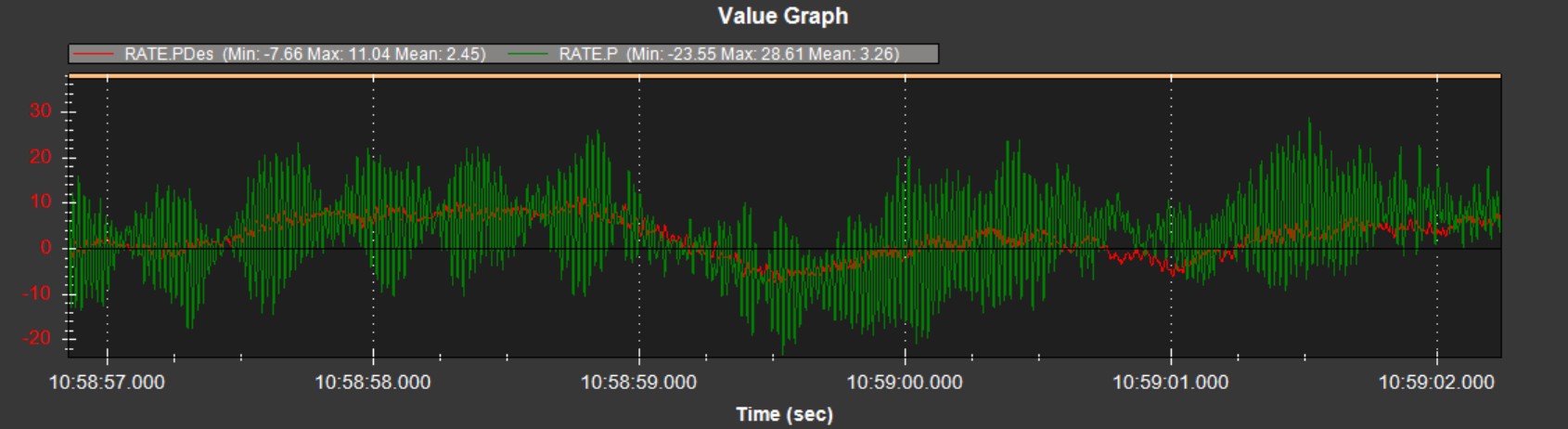
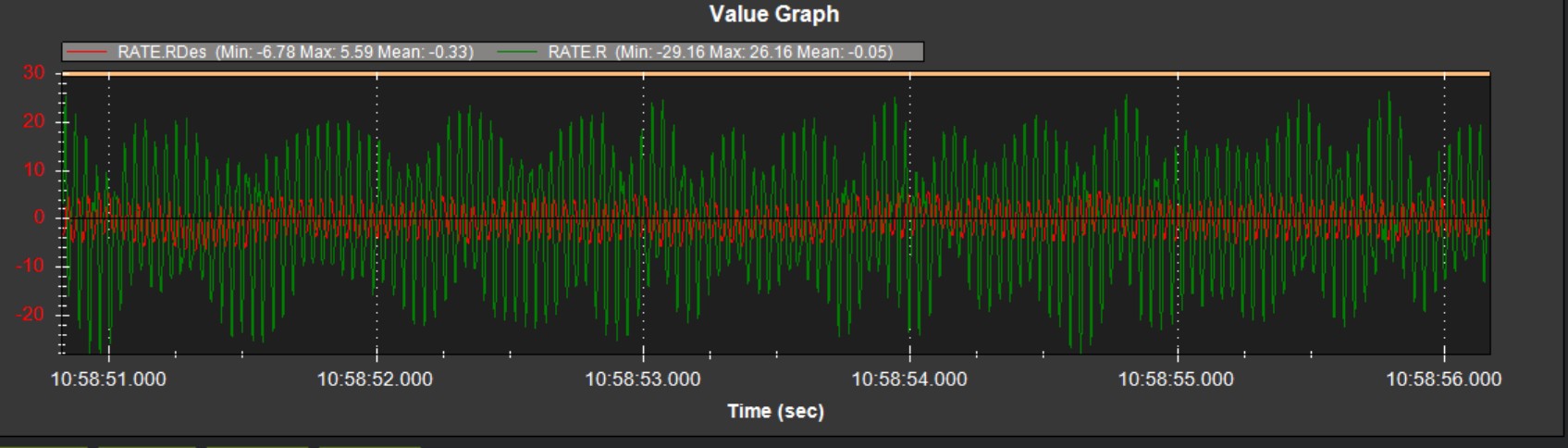
You have output and Rate oscillation. Rate oscillation is particularly bad.The Notch filter is misconfigured so it’s it not tracking anything.
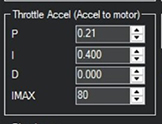
Set the Vertical Acceleration Controller gains based on hover throttle (~0.13).
Forget the FFT based Notch filter and use a simple throttle based one.
The Rate PID’s need work but Auto Tune likely will error out from the oscillation. Do the above and run Quick Tune which probbaly will run. The run Auto Tune.
Or, you could try the Methodic Configurator again which covers all of these things.
Here are some examples of what you don’t want to see so you can reproduce them yourself during the tuning process.
Looking at the logs a bit more, there’s really something moving on the Y axis. The vibration levels aren’t bad but I think it’s creating a resonance that’s showing up in the filter. It’s at a low enough frequency that (just making some guesses in my head) it might be a multiple of the two bladed propellers. Have a good look at the antennas and the mounting for everything. Be sure that nothing is moving or loose.
I differ in some of your build choices: (These are my opinions and advice. Like all free advice it’s worth everything you paid for…)
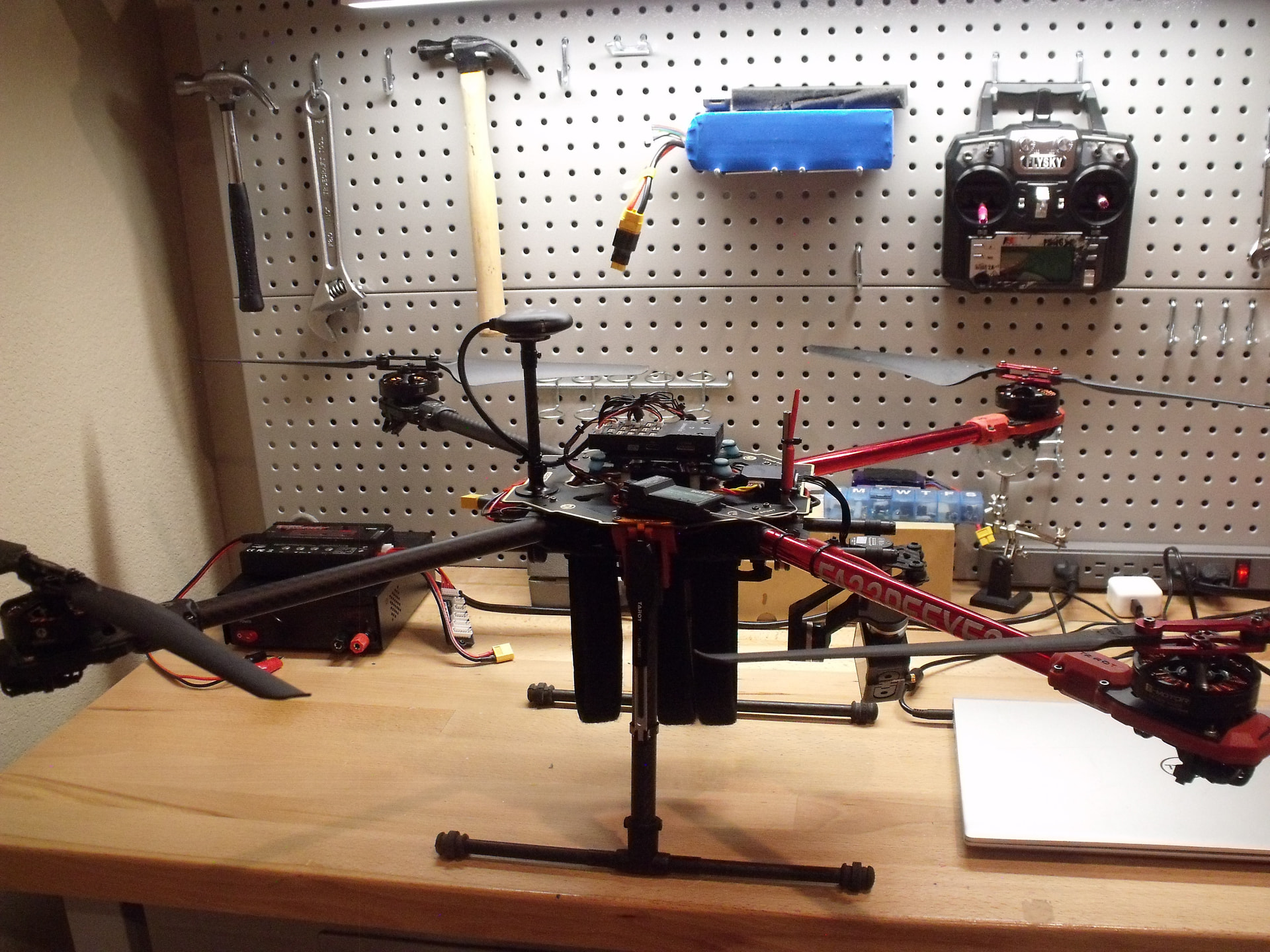
I don’t like those GPS antennas on the masts. I have always found those masts to be more source for problems than any good they have ever done. If those are the folding variety then that could be contributing to the issues that are showing up in the filters. My choice would be to mount the antenna lower on a mount that is more rigid. Do you have access to a 3D printer?
I also don’t use soft mounting of the flight controller. That too could be a source of the problems. My choice it to hard mount the controller unless I’ve proven there’s an issue or I’m using gas engine.
Thanks all for your feedback. This particular build has been trouble from the beginning, and I’m sorely tempted to retire it. Some of my build choices were based on recommendations I had gotten in the past as well as my concern about performance being at a higher elevation (5K ft), which turned out to be a non-issue. At one point, I had mounted the ESCs withing the center of the aircraft which necessitated a third deck but I later removed the deck and mounted the ESCs underneath the motors. My choice of using a long mast for the GPS was out of my desire to isolated it from electrical interference, but as was pointed out, it is not rigid. The f.c. mount choice was out of a desire to isolate from vibrations. I don’t know how else to mount it.
I don’t have access to a 3-D printer. I can shorten the GPS mast of see if I can get help at the local library which has a 3-D printer and an instructor.
I know nothing about throttle-based tuning - will do some research on that. OR I may simply retire the aircraft and focus on the other Tarot quad which is more of a stock build.
You don’t have to retire it. It could be fairly straight forward to get this tuned.
Chop the mast way down and get rid of the FC mounting plate as @Allister suggested and just use 3M foam to stick it down.
Set the Vertical Acceleration controller gains (PSC parameters) properly as mentioned.
Disable the notch filter you have set and set this INS_BAT_LOG_OPT,4 and disable Fast IMU in the log bitmask.
Make another hover flight and we can sort the Notch filter and offer some other suggestions after seeing the log.Like others have experianced I think you got some junk in the parameters from Rosser’s guides. I don’t see anything fundamentally wrong with this craft. It’s in a state many craft are pre-tune.
I don’t think you need to retire it. Everything is working well enough that some time spent tuning and tweaking will yeld good results.
My default go to for flight controllers (if there aren’t screw mounts) is to use double sided Gorilla tape. It’s ~2mm thick and holds the universe together. Make sure everything is clean and you’ll be fine. (if you re-mount the flight controller don’t forget to re-do the Accel calibrations)
You might even be able to get away with just cutting that mast shorter. Just high enough to get it away from everything. That will take out a lot of the flex.
If you can adjust those two things then I would re-fly to get some data for the filter. Get the mechanical stuff going first then the params. I could suggest some starting filter settings if you want. They won’t be perfect if you make the phyiscal changes but enough to get you started.
As for altitutde, I fly between 1000 and 1500m (or 3500 and 5000 ft) and it’s never really been an issue other than sometimes shorter than advertised battery performance. Honestly temperature is a bigger variable for most things here.
I think that I will leave the f.c. as is as I have the landing gear controller sitting underneath - that’s why I have raised screws in order to raise the mount. I did find, in my box-o-parts, a shorter and more robust mast for the GPS and is a tad shorter. Of course, I will have to re-do the compass calibration.
I will try working on the PID controllers and throttle tuning, probably using Chris Rosser’s videos as a guide. IT I succeed in making any improvements I will repeat the process on my other Tarot quad. THanks again!
You don’t have to take our word that this is a mistake. Use search on the forum here for other opinions.From Developers. The same Developers that have have published proven guides to configuration and tuning.
You can use the flight collecting usable data to configure the notch filter for that with Magfit. You are using that process right?
Actually, I’m following the steps recommended by Chris Rosser on YouTube. I started the PID tuning procedure click here. I enabled FFT on order to unmask the other FFT parameters and entered the values for MAXHX, MINHZ and WINDOW_SIZE. But I had a problem calculating FFT_MAXHZ as the value I calculated based on my 6S lipo voltage and 400KV motors - 13.6 was below the min range of 20, so I entered the value of 20.
I did a short test flight this morning to gather log info - haven’t yet reviewed it. But I had trouble hovering in STABILIZE mode = it would either climb or descend. I clearly need to do some throttle tuning! Landing was a bit rough as I almost touched down, I glanced down at the transmitter at the arm/disarm switch and I disarmed before it touched down - just a few inches about ground, no damage.I clearly need to practice landings as it is until I do the throttle tuning.
Well guys, I’m conflicted as to how to proceed. The advice I’m getting is to abandon using C.R. even though I haven’t (yet) encountered any errors, though admittedly I’m just beginning. I have bad results trying to use the AMC and sorry guys - I will not go down that path.
Currently, my most pressing issue is getting the throttle tuned to the point that I can maintain a hover manually and land safely. During this morning’s flight I was unable to hover - there is a delay from command/response, so that when the aircraft descends and it doesn’t respond right away to increased throttle input, I instinctively add more throttle, resulting in a climb.
I’ve gone through the First Flight and Tuning guide, but it doesn’t shed light on fixing the delay and references parameters that I don’t see in my parameter list.
Right now, I need some advice on how to proceed with reducing throttle lag so that I can manually hover and safely land. The aircraft has V4.6.3 .
Perhaps you should sign on to a Rosser support plan and provide him with the log files. I understand you can get support thru his Discord channel also.
I think it would be best to start from the beginning and follow the standard ArduPilot Copter tuning procedure.
It seems that the basic tuning process has not been completed yet. ESC calibration and the Motor Test appear to have been done correctly, but some of the minimum tuning steps required before normal flight are still missing.
I would recommend starting from this section:
Based on what I can see in the log, the hardware specifications appear to be:
17-inch propellers
6S battery
It would also be a good idea to configure INS_POS and GPS1_POS correctly. This will allow the tuning and sensor calculations to be based on the correct reference point and axes.
From the first photo, the center of gravity appears to be located slightly below the flight controller. The GPS also seems to be mounted toward the rear-right side of the vehicle.
Setting these positions correctly first would provide a better baseline before proceeding with the tuning process.
It also looks like the flight controller may not be mounted perfectly level from a hardware perspective.
Since you are using folding propellers, there is also a possibility of resonance depending on the propeller blade tension. Adjusting the folding blade tension evenly and sufficiently may help reduce vibration and resonance.
It also appears that you are using a relatively high-capacity 6S battery. Considering the additional weight, the motors may require a fairly high amount of power under load.
In that case, using an XT60 connector for the main power connection could become a long-term reliability and safety concern. If possible, I would recommend using at least an XT90 connector for the main battery power connection.
For the wiring connected to each FC port, I also think it would be better to twist the individual signal and power wire pairs rather than simply bundling them together with cable ties. This can help with both noise reduction and cleaner cable management.