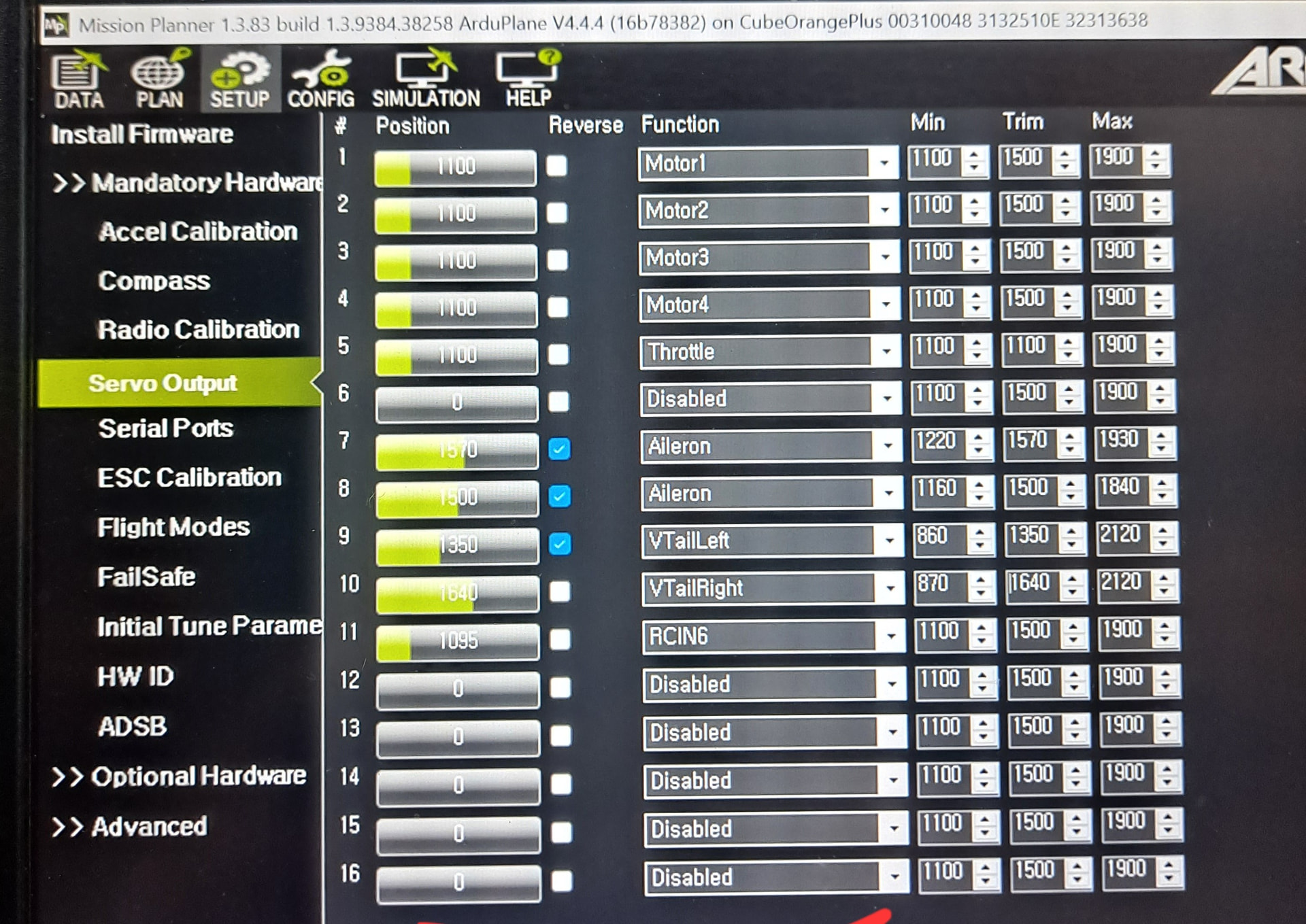
I am looking for advice on a critical post-transition roll issue and whether our aggressive servo trim settings might be the cause. Our setup is a 25kg MTOW QuadPlane with a rear DA50 gas pusher engine, ArduPlane 4.4.4 on CubeOrange Plus, and Hitec DB961WP servos (operating range 900-2100µs).
1. Background: Altitude Loss & V-Tail Trim Setup
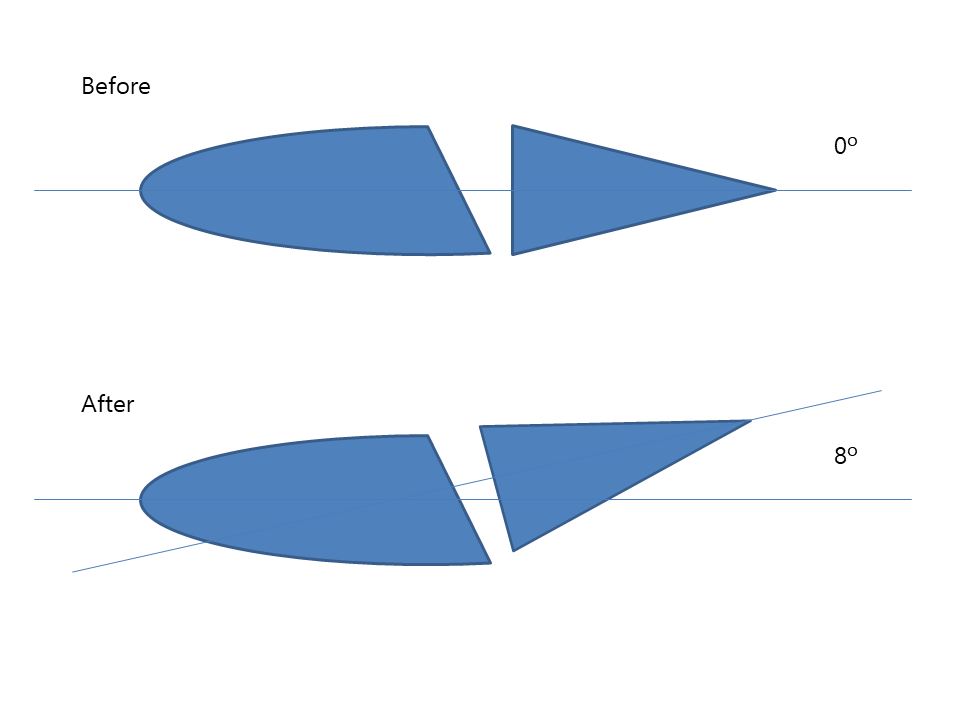
Previously, our aircraft consistently lost about 40 meters of altitude immediately after completing the forward transition. To counteract this, we adjusted the mechanical neutral of the V-Tail so that when the airfoil is at 0 degrees, the ruddervators are pitched up by 8 degrees. As a result, our SERVO_TRIM deviates significantly from the standard 1500µs.
The aircraft had been flying perfectly for an accumulated 300km. However, it recently developed a severe anomaly: right after [TRANSITION DONE], it abruptly rolls 60 degrees to the right and drops.
The logs show that DesRoll is commanding a maximum left roll (up to the LIM_ROLL_CD limit).
The servo outputs (both Ailerons and Ruddervators) also clearly command a hard left roll.
Despite these left commands, the aircraft consistently rolls right.
3. Ruling Out Engine EMI
Because we use a rear gas engine, we initially suspected that ignition spark noise (EMI) might be interfering with the tail control surfaces. However:
Ground tests with the engine running showed no EMI-induced jitter or uncommanded servo movements.
The anomaly is highly selective—it only occurs at the exact moment transition ends. Also, it always rolls right despite commanding left, making random EMI noise highly unlikely.
4. My Questions
Given our Hitec servos’ wide range (900-2100µs):
Is it aerodynamically sound to offset the TRIM PWM significantly from 1500µs to maintain the +8° pitch-up?
Could this offset be asymmetrically limiting our PWM range, causing the servos to “blow back” under aerodynamic load or fail to overcome the DA50 engine’s reaction torque when the lifting motors shut off?
Note: I do not have the .bin log on hand right now, but I will definitely upload it later this week! Any initial thoughts would be greatly appreciated.
Update: Follow-up Test Results & In-Flight Video/Logs
Hi everyone,
Here is a quick update on the post-transition 60° right-roll issue I posted about earlier.
Over the past week, we conducted extensive troubleshooting to isolate any hardware or sensor failures. We systematically replaced:
Flight Controller (swapped with a fresh CubeOrange+)
GPS module
Airspeed sensor, pitot tube, and silicone tubing
Ruddervator servos (replaced with new units)
Despite these replacements, we conducted 7 test flights, and in all 7 attempts, the exact same hard right-roll anomaly persisted immediately after transition.
In-Flight Visual Check (Ruddervators)
To definitively verify whether ignition EMI was causing erratic servo flutter or uncommanded deflection under load, we mounted a rear-facing RunCam aimed at the V-tail.
Reviewing the onboard footage, the ruddervators appear to be actuating normally and deflecting smoothly as commanded—there is no visible flutter or uncommanded deflection. You can view the footage here:
Control Tuning: Some of my colleagues suspect a parameter or gain issue. However, I tend to keep parameters close to default and minimize unnecessary changes. We haven’t even run Autotune on this platform, simply because its baseline handling had always been exceptionally solid and stable.
Flight History: This airframe already has over 300 km of accumulated flight history with zero transition anomalies.
Potential Triggers: This issue only began appearing recently, right after either:
Directly following a successful 2.5-hour endurance flight, or
A long-distance ground transit of the airframe.
Since that point, the right-roll at transition has been 100% reproducible.
Has anyone encountered a similar behavior where an airframe suddenly develops an uncontrollable roll post-transition despite normal surface deflections and replaced avionics? Any insights, log analysis, or pointers would be sincerely appreciated.
[Update: SOLVED] The culprit was found — and it was an embarrassingly simple mistake.
Hi everyone,
First and foremost, I want to extend my sincere apologies and deepest gratitude to anyone who took the time to review our logs, analyze the video, or brainstorm potential causes with us.
It turns out the issue was neither a firmware bug, a V-tail mixing saturation, nor ignition EMI. The root cause was shockingly simple—and frankly, an embarrassing oversight on our part.
The Cause: A Peeling Label on the Right Wing
Prior to the test flights, we had taped an A4 paper label (an asset management ID) onto the upper surface of the right main wing using clear tape.
Upon closer inspection, we discovered that the leading edge of the tape had slightly lifted and peeled away from the wing surface.
This created a small, tunnel-like scoop between the wing’s upper skin and the tape:
As the aircraft reached transition speed, high-velocity airflow entered this pocket.
Instead of maintaining clean, attached flow over the airfoil, it caused severe boundary layer separation and turbulence directly ahead of the right aileron.
The disrupted airflow effectively spoiled the aerodynamic authority of the right control surface.
The moment [TRANSITION DONE] was reached and the quad lift motors turned off, the right wing immediately dropped, and the stalled/spoiled aileron had zero control authority to counter the roll—explaining why the aircraft violently rolled right despite commanding full left roll.
Resolution
We removed the label, thoroughly cleaned the wing surface, and conducted a test flight. The aircraft transitioned flawlessly and flew completely level, exactly as it had during its first 300 km.
It is a humbling reminder that even in complex UAV systems with advanced avionics, basic aerodynamics and surface cleanliness come first before suspecting hardware or software anomalies.
Again, I am truly sorry for taking up your valuable time over such a silly oversight, and I genuinely appreciate the support and expertise of this wonderful community.